
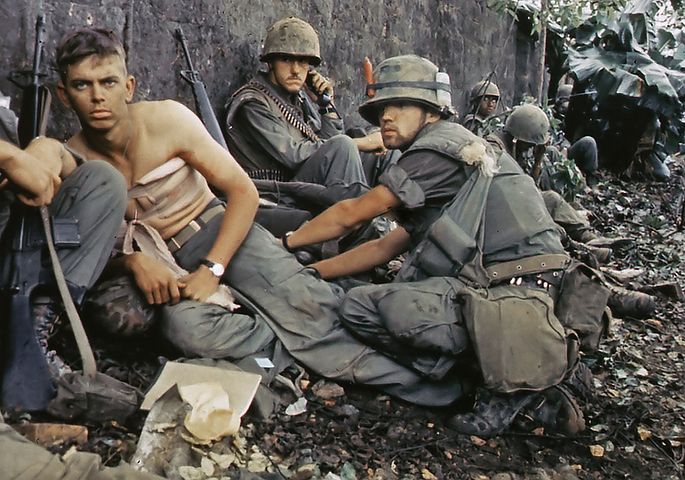
The Vietnam War was a long, costly and destructive battle that pitted North Vietnam’s communist government against South Vietnam and its primary ally, the US. The raging Cold War between the US and the Soviet Union escalated the dispute. About 3 million people (including more than 58,000 Americans) were killed in the Vietnam War and about half of those killed were Vietnamese civilians. Opposition to the war in the United States bitterly divided Americans, even after President Richard Nixon ordered the withdrawal of U.S. forces in 1973. Communist forces ended the war by seizing control of South Vietnam in 1975, and the country was unified as the Socialist Republic of Vietnam the following year.
The Vietnam conflict has had a number of effects on the veterans. Many troops in battle endured brutality and lost friends to the atrocities of fighting. Many American soldiers suffered mental and physical disabilities they’d bear for the rest of their lives. Many stayed proud of their contribution and the United States’ position in the war. During the war approximately twenty-seven million American men dealt with the draft; 11 percent of them served in some fashion in Vietnam.
Although most veterans were not permanently damaged by the war, some 15 to 25 percent of Vietnam veterans (between 500,000 and 700,000) suffered from a stress-related impairment known as post-traumatic stress disorder (PTSD), a psychological disease brought on by acute combat experience. Some of the 11,500 women who served in the war—90 percent of them as nurses—also returned exhibiting PTSD. This condition can occur in combat soldiers or other individuals suffering from violent trauma and can manifest itself years after the initial experience. Also known as shell shock or combat fatigue, the disorder is vaguely defined and was overused in diagnosing the psychological reactions to war of Vietnam veterans.
Despite the stereotype of the chronically impaired Vietnam veteran, most vets married, found jobs, and successfully reintegrated into American society. Many became successful businessmen and politicians whose experiences in the war shaped subsequent U.S. policy toward Vietnam. They became the point men leading the nation to a complex but more hopeful phase of Vietnamese-American relations.
Robert E. Wright, a proud Vietnam war veteran and author of the book “Weapons of War: A Compilation of Letters Recounting a Soldier’s Story of Service, Love, and Faith”, is no stranger to the cruelty of armed conflict.
Coincidentally, Robert was born on “Veterans Day”, November 11th, 1949 in Indianapolis Indiana. He grew up in Lockefield Gardens, an inner-city housing project located two miles west of downtown Indianapolis. In June of 1968, he graduated from Crispus Attucks High School in Indianapolis, and received a Diploma from Indiana Christian University in Old and New Testament Studies May of 1983. On May 10th, 2014, he received an Associates of Arts Degree majoring in “Leadership and Ministry” from Crossroads Bible College in Indianapolis Indiana. On, May 9th, 2015 he proceeded to receive a Bachelor of Science Degree in “Church Management and Ethics” from Crossroads Bible College.
“Weapons of War: A Compilation of Letters Recounting a Soldier’s Story of Service, Love, and Faith” tells a love story far greater than a war story. In it, Robert E. Wright gives us letters he sent to Barbara Hampton during his two years in the U.S. Army, which included a 1969-70 tour in Vietnam as an infantryman with the 101st Airborne Division, the Screaming Eagles.
The book works as a love story because Wright’s weapons of war were his M-16 to fight the NVA and Viet Cong; his pen to fight the loneliness and separation he felt; and his faith in God to fight fear and doubt. The power of the latter two exceeded that of the first. His letters concentrated on convincing Hampton that she was his one-and-only love forever.
As a grunt, Wright repeatedly walked point on lengthy search-and-destroy missions; turned a VC defector into a Kit Carson Scout; and cleared remote landing zones. His awards included the Bronze Star, two Air Medals, and the Army Commendation Medal.
Without a doubt, this masterpiece of a book is a moving account through letters and pictures of a soldier’s story. While Robert Wright was fighting in the jungles of Vietnam, his fiancé was the first African-American cheerleader at Ball State University. They were living very different lives after graduating from high school, but their love, letters, and faith helped Robert survive the trial of combat. He came home as a decorated hero, Barbara graduated from college, and they really did live happily ever after until Barbara’s early death. Robert rediscovered his letters at home. He matched them with photos from his experiences in Viet Nam, and this book is the result.
The book, aside from detailing the atrocities of war, beautifully illustrates what it means to be really committed in a relationship and how to care for someone or something outside of ourselves, a truly remarkable accomplishment for a young man in his early twenties.
“(This book) has given me the opportunity to tell my Vietnam story and how it affected me, my fiancée, and my family. It will give my family a written record of my service to my country. And to thank the United States Army for its role in shaping my character and developing me into a responsible leader ready and equipped to take on any challenge or mission. In other words, helping me to ‘be all that I can be’, and to finally tell my story of how the Army took a ‘Raw Recruit’ and turned him into a trained combat soldier and proven leader”, explains Robert.
Robert Wright, indeed, created a masterpiece from his experiences during the Vietnam War that touches the hearts of the readers.
 Alex Writes